

Blog
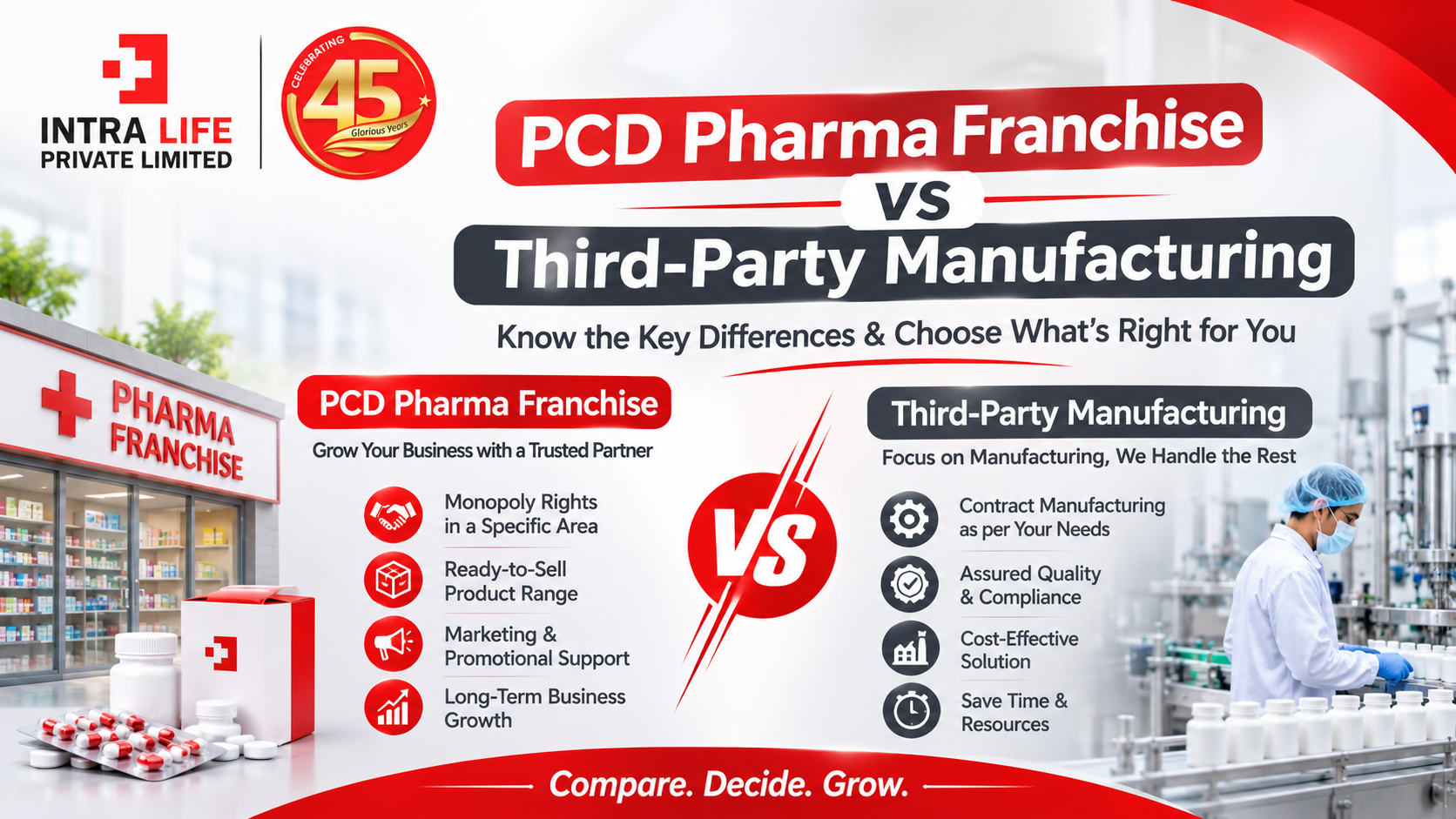
PCD Pharma Franchise vs Third-Party Manufacturing
- 25-11-2026
The Indian pharmaceutical industry offers several business opportunities for distributors, entrepreneurs, medical representatives and pharmaceutical companies. Two popular models are the PCD pharma franchise business and third-party pharmaceutical manufacturing. Both allow businesses to participate in the pharmaceutical market without necessarily owning a manufacturing facility, but their operations, investment requirements, responsibilities and growth opportunities are different.
If you are planning to enter the pharmaceutical industry, understanding the difference between a PCD pharma franchise and third-party manufacturing can help you choose the right business model.
A PCD pharma franchise is generally suitable for entrepreneurs who want to market and distribute medicines under an established pharmaceutical company's brand. Third-party manufacturing is more suitable for businesses that want to develop and sell pharmaceutical products under their own brand while outsourcing the manufacturing process to a qualified manufacturer.
In this guide, we explain the key differences, investment considerations, advantages, challenges and factors to consider before choosing either model in India.
What Is a PCD Pharma Franchise?
A PCD (Propaganda Cum Distribution) pharma franchise is a business arrangement in which a pharmaceutical company authorises an individual, distributor or business partner to promote and distribute its products within an assigned geographical area.
The franchise partner purchases pharmaceutical products from the company and markets them to eligible customers, such as pharmacies, stockists, hospitals and healthcare institutions, in accordance with applicable regulations.
Many pharmaceutical companies offer monopoly rights, meaning one authorised partner receives exclusive marketing and distribution rights for a defined territory, subject to the agreement.
How Does a PCD Pharma Franchise Work?
The process generally follows these steps:
-
Select a pharmaceutical company: Research its experience, product portfolio, quality standards and business reputation.
-
Choose a product division: Identify therapeutic categories that match the requirements of your target market.
-
Check territory availability: Confirm whether the company offers monopoly rights in your preferred city or district.
-
Complete documentation: Arrange the applicable drug licence, GST registration and other required business documents.
-
Place the initial order: Purchase products according to the agreed commercial terms.
-
Start marketing and distribution: Develop relationships with pharmacies, distributors and eligible healthcare customers.
-
Manage business operations: Monitor inventory, customer requirements, collections and repeat orders.
Key Features of a PCD Pharma Franchise
-
Operate under an established pharmaceutical company's brand.
-
Access an existing product portfolio.
-
Receive promotional and marketing support, depending on the agreement.
-
Obtain territory-based distribution or monopoly rights where offered.
-
Focus on product marketing, sales and distribution rather than manufacturing.
-
Build relationships with pharmacies, distributors and healthcare institutions.
What Is Third-Party Pharma Manufacturing?
Third-party pharmaceutical manufacturing is a business arrangement in which a pharmaceutical company outsources the production of medicines to another manufacturing company with the required facilities, licences and regulatory approvals.
In this model, the business placing the manufacturing order generally sells the finished products under its own brand name, subject to applicable regulatory requirements and contractual arrangements.
For example, a pharmaceutical business may want to launch its own range of tablets, capsules, syrups, ointments or injections. Instead of establishing a manufacturing plant, it can approach an eligible third-party manufacturer to produce the formulations.
The manufacturer handles the agreed production activities, while the brand owner is responsible for its commercial strategy, branding, product selection and other obligations assigned under the manufacturing agreement.
How Does Third-Party Pharma Manufacturing Work?
The process usually involves the following steps:
-
Identify the product requirements: Decide which formulations, strengths and dosage forms you want to launch.
-
Find a suitable manufacturer: Evaluate manufacturing capabilities, licences, quality systems and regulatory compliance.
-
Discuss product specifications: Finalise formulation requirements, packaging, labelling and other technical details.
-
Confirm commercial terms: Discuss minimum order quantities (MOQs), pricing, payment conditions and production timelines.
-
Complete regulatory documentation: Finalise the applicable manufacturing, product, labelling and quality documentation.
-
Approve samples and packaging: Review the agreed product specifications and artwork before production.
-
Manufacture and quality-check products: The manufacturer produces the products and completes the required quality-control procedures.
-
Receive and market the products: The brand owner manages distribution, sales, promotion and market development.
Key Features of Third-Party Pharma Manufacturing
-
Launch pharmaceutical products under your own brand, subject to applicable approvals.
-
Avoid the capital expenditure involved in establishing a manufacturing plant.
-
Select formulations and product categories based on market requirements.
-
Work with specialised manufacturing facilities.
-
Manage your own branding, packaging and commercial positioning.
-
Build a pharmaceutical product portfolio over time.
PCD Pharma Franchise vs. Third-Party Pharma Manufacturing: Key Differences
Although both models involve working with an external pharmaceutical company, their business structures are different.
| Comparison Factor | PCD Pharma Franchise | Third-Party Manufacturing |
|---|---|---|
| Business model | Marketing and distribution partnership | Outsourced product manufacturing |
| Brand ownership | Products are marketed under the pharmaceutical company's brand | Products are generally marketed under your own brand |
| Main responsibility | Sales, promotion and distribution | Product development coordination, branding and sales |
| Manufacturing | Handled by the pharmaceutical company or its manufacturing partners | Outsourced to the contracted manufacturer |
| Product selection | Choose from the company's available portfolio | Select or develop products based on manufacturer capabilities |
| Territory rights | Monopoly rights may be available | Depends on the manufacturing and distribution agreements |
| Marketing support | May include promotional materials and product information | Usually managed by the brand owner |
| Initial investment | Generally focused on stock, licences and marketing | Depends on product range, MOQs, packaging and development requirements |
| Business control | Operate within the company's product and brand framework | Greater control over branding and product positioning |
| Suitable for | Distributors, medical representatives and entrepreneurs | Pharma businesses, established distributors and brand owners |
In simple terms: A PCD pharma franchise helps you sell an existing company's products in an assigned territory, whereas third-party manufacturing helps you create and sell products under your own pharmaceutical brand without operating your own manufacturing plant.
7 Major Differences Explained
1. Business Ownership and Brand Identity
Brand ownership is one of the most important differences between these two models.
In a PCD pharma franchise, you promote and distribute products under the pharmaceutical company's existing brand. You benefit from its established product portfolio and brand identity, but you operate within its commercial policies and agreed territory.
In third-party manufacturing, you generally develop your own brand identity. You can select product names, packaging designs and brand positioning, subject to trademark, labelling and regulatory requirements.
Example:
-
PCD franchise: A distributor markets medicines supplied by an established pharmaceutical company under its existing product names.
-
Third-party manufacturing: A pharmaceutical business gets tablets manufactured by an approved third-party facility and markets them under its own approved brand name.
2. Initial Investment and Business Costs
The investment requirements depend on the company, product categories, order quantities and business scale.
A PCD pharma franchise usually requires investment in:
-
Initial pharmaceutical stock.
-
Applicable drug licence and registrations.
-
Promotional activities.
-
Transportation and distribution.
-
Working capital for repeat orders.
Third-party manufacturing may involve:
-
Product development or formulation-related costs.
-
Minimum manufacturing order quantities.
-
Packaging and artwork.
-
Testing and quality documentation.
-
Regulatory and product-related expenses.
-
Warehousing, marketing and distribution.
For a new entrepreneur, a PCD franchise may offer a more accessible entry route because the business can begin with an existing product portfolio. However, a third-party manufacturing business may provide greater control over product branding and long-term portfolio development.
There is no fixed investment amount for either model. Obtain a detailed quotation before making a financial commitment.
3. Product Selection and Portfolio
In a PCD pharma franchise, the available product range is determined by the pharmaceutical company's portfolio. Partners can select products from the available divisions, subject to commercial terms and territory availability.
Common product categories include:
-
General medicines.
-
Antibiotics and anti-infectives.
-
Cardiac and diabetic care.
-
Gastrointestinal medicines.
-
Orthopaedic and pain management products.
-
Dermatology products.
-
Gynaecology and paediatric products.
-
Nutraceuticals and wellness products.
In third-party manufacturing, businesses can discuss specific formulations, strengths, dosage forms and packaging requirements with the manufacturer.
The final product range depends on the manufacturer's capabilities, technical feasibility, regulatory permissions and commercial terms.
4. Marketing and Promotional Support
Marketing support can influence how quickly a pharmaceutical business establishes its market presence.
In a PCD pharma franchise, the pharmaceutical company may provide promotional materials such as:
-
Visual aids.
-
Product cards and literature.
-
Promotional gifts, where permitted.
-
Product catalogues.
-
Samples, where legally permitted.
-
Marketing guidance.
The availability and scope of support differ from one company to another.
In third-party manufacturing, the brand owner generally takes responsibility for creating its marketing strategy. This includes product branding, promotional materials, sales-team development and distribution planning.
Therefore, businesses choosing third-party manufacturing should account for marketing expenses separately.
5. Manufacturing Responsibilities and Quality Control
In a PCD pharma franchise, the franchise partner generally does not manage the manufacturing process. The pharmaceutical company is responsible for arranging product supply through its manufacturing operations or contracted facilities, as applicable.
In third-party manufacturing, the brand owner works directly with the contracted manufacturer on product specifications, production planning, quality documentation and delivery requirements.
Before selecting a manufacturer, evaluate:
-
Applicable manufacturing licences.
-
GMP and relevant quality-system certifications.
-
Manufacturing capabilities and dosage forms.
-
Quality-control and testing procedures.
-
Batch documentation and Certificate of Analysis (COA), where applicable.
-
Product traceability and complaint-handling procedures.
-
Regulatory compliance and agreement terms.
Remember that a certification or quality claim should be verified for the specific manufacturing site and product. Do not assume that every facility operated by a company has identical approvals.
6. Business Risk and Operational Responsibilities
Both business models involve commercial and regulatory risks, but the responsibilities differ.
A PCD franchise partner must manage stock movement, customer relationships, local competition, expiry management, collections and territory development.
A third-party manufacturing brand owner must additionally coordinate with manufacturers, monitor production schedules, manage product specifications, review packaging and ensure that the brand's regulatory responsibilities are fulfilled.
Neither model guarantees profitability. Success depends on product demand, pricing, quality, supply reliability, regulatory compliance and business execution.
7. Business Expansion and Long-Term Growth
A PCD pharma franchise can expand through:
-
Developing new customer relationships.
-
Increasing product sales within the assigned territory.
-
Adding more product divisions where permitted.
-
Expanding distribution coverage.
-
Applying for additional territories, subject to availability.
Third-party manufacturing businesses can expand by:
-
Introducing additional product formulations.
-
Developing new pharmaceutical brands.
-
Entering new therapeutic categories.
-
Increasing manufacturing volumes.
-
Building a wider distribution network.
-
Exploring eligible institutional or export markets.
The better model depends on whether your priority is building a distribution business or developing your own pharmaceutical brand.
Advantages of a PCD Pharma Franchise Business
A PCD pharma franchise can be a practical option for people who want to enter pharmaceutical marketing and distribution without establishing a manufacturing facility.
1. Access to an Existing Product Portfolio
You can choose from an established company's available products rather than developing every formulation independently.
2. Monopoly Rights
Some pharmaceutical companies provide exclusive territory rights. This can help reduce direct competition from other franchise partners of the same company within the agreed territory.
Always check the geographical boundaries, duration, conditions and termination clauses in the written agreement.
3. Promotional Support
Companies may provide product literature, visual aids and other promotional resources to support local marketing.
4. Established Supply Network
Working with a company that has an organised supply system can make product procurement and inventory planning easier.
5. Suitable for New Entrepreneurs
People with relevant industry experience, distribution networks or pharmaceutical sales knowledge may find this model easier to understand than setting up their own manufacturing and branding operation.
Advantages of Third-Party Pharma Manufacturing
Third-party manufacturing can be suitable for pharmaceutical businesses that want to establish their own brands and develop a wider product portfolio.
1. Own Pharmaceutical Brand
You can build brand recognition through your own product names, packaging and positioning, subject to applicable approvals.
2. No Need to Establish a Manufacturing Plant
Outsourcing production avoids the need to invest directly in land, buildings, production equipment and manufacturing infrastructure.
3. Product Portfolio Flexibility
You can discuss different formulations and dosage forms according to market demand and the manufacturer's capabilities.
4. Greater Branding Control
You can develop your own packaging, product identity and commercial strategy within regulatory requirements.
5. Opportunity for Business Expansion
As your business develops, you can explore additional formulations, therapeutic segments and distribution markets.
Which Is Better: PCD Pharma Franchise or Third-Party Manufacturing?
There is no single answer because the right choice depends on your business goals, investment capacity, industry experience and long-term plans.
| Your Business Goal | Recommended Model |
|---|---|
| Start a pharmaceutical distribution business | PCD Pharma Franchise |
| Enter the pharma industry with an existing product portfolio | PCD Pharma Franchise |
| Obtain monopoly rights in a defined territory | PCD Pharma Franchise, if offered |
| Market products under your own brand | Third-Party Manufacturing |
| Develop a customised pharmaceutical portfolio | Third-Party Manufacturing |
| Build an independent pharmaceutical brand | Third-Party Manufacturing |
| Focus mainly on local distribution and sales | PCD Pharma Franchise |
| Expand an existing pharma brand's product range | Third-Party Manufacturing |
Choose a PCD Pharma Franchise If:
-
You want to start a pharmaceutical marketing and distribution business.
-
You prefer selling products under an established company's brand.
-
You want access to an existing product portfolio.
-
You need promotional support from the pharmaceutical company.
-
You want to explore monopoly rights in your city or district.
-
You have the required licences, business resources and customer-development capabilities.
Choose Third-Party Manufacturing If:
-
You want to launch your own pharmaceutical brand.
-
You already have a distribution network or sales team.
-
You want greater control over product selection and packaging.
-
You can manage manufacturing coordination and regulatory responsibilities.
-
You have the working capital required for minimum order quantities and marketing.
Important Factors to Check Before Choosing a Pharma Business Model in India
Before entering either business model, evaluate the following factors carefully.
1. Verify Licences and Regulatory Compliance
Check the applicable drug licences, GST registration, manufacturing permissions and other regulatory requirements. The exact requirements depend on the products, activities and business structure.
2. Evaluate the Company's Product Quality
Review the manufacturing facilities, quality systems, product documentation and relevant certifications. Verify claims rather than relying only on marketing material.
3. Understand the Commercial Agreement
Read the agreement carefully, including pricing, payment conditions, supply commitments, territory restrictions, product ownership, intellectual property, returns and termination provisions.
4. Check Minimum Order Requirements
For PCD franchises, understand the opening stock and repeat-order requirements. For third-party manufacturing, confirm product-wise MOQs, production timelines and packaging costs.
5. Study Market Demand
Research the therapeutic segments, competition, customer requirements and product demand in your target territory.
6. Evaluate Supply Reliability
Consistent supply is important for maintaining customer relationships. Understand lead times, dispatch processes, stock availability and procedures for handling shortages.
7. Plan Working Capital
Do not calculate investment only from the first order. Include transportation, storage, marketing, salaries, credit periods, inventory and other operating expenses.
How Intra Life Supports Pharmaceutical Business Opportunities
Intra Life is an established pharmaceutical company offering PCD pharma franchise opportunities across India. Its business model includes a broad pharmaceutical product portfolio, territory-based franchise opportunities and partner support.
According to its official website, Intra Life highlights:
-
46+ years of industry experience.
-
3,500+ pharmaceutical products.
-
2,200+ distributors nationwide.
-
1,000+ franchise partners.
-
City-wise monopoly franchise opportunities.
-
Promotional and marketing assistance.
-
Product supply and business support.
For entrepreneurs interested in a PCD pharma franchise, Intra Life provides an opportunity to explore available product categories and territory options.
Businesses interested in third-party manufacturing should separately discuss their product requirements, manufacturing arrangements, applicable documentation, minimum quantities and commercial terms with the company.
Before proceeding, confirm the latest product availability, territory status and manufacturing capabilities directly with the company.
Explore Intra Life:
-
PCD Pharma Franchise: https://www.intralifeindia.com/monopoly-pcd-pharma-franchise.php
-
Company Profile: https://www.intralifeindia.com/our-profile.php
Frequently Asked Questions (FAQs)
1. What is the main difference between a PCD pharma franchise and third-party manufacturing?
A PCD pharma franchise allows a business partner to market and distribute an existing pharmaceutical company's products. Third-party manufacturing allows a pharmaceutical business to outsource product manufacturing and generally sell the finished products under its own brand.
2. Which is better for beginners: PCD pharma franchise or third-party manufacturing?
A PCD pharma franchise may be more suitable for beginners who want to enter pharmaceutical distribution using an existing product portfolio. Third-party manufacturing may be better for businesses with the resources and experience to manage their own brands, product requirements and regulatory responsibilities.
3. Is third-party pharma manufacturing profitable in India?
Third-party pharma manufacturing can offer business opportunities, but profitability depends on product demand, manufacturing costs, minimum order quantities, regulatory compliance, branding, marketing expenses and distribution efficiency. Profit is not guaranteed.
4. Can I start a pharma business without owning a manufacturing unit?
Yes. A PCD pharma franchise or third-party manufacturing arrangement can allow businesses to operate without owning a manufacturing facility. However, the applicable licences, permissions and regulatory responsibilities must still be fulfilled.
5. Do PCD pharma franchise companies provide monopoly rights?
Some PCD pharma companies provide monopoly rights for a particular city, district or territory. These rights depend on the company's policy and the written agreement. Always verify the exact territory and exclusivity conditions before making an investment.
6. Can I sell third-party manufactured medicines under my own brand name?
Generally, yes, subject to applicable drug regulations, product approvals, trademark requirements, labelling rules and contractual arrangements with the manufacturer. Confirm the legal requirements for each product before launching it.
7. What documents are required to start a PCD pharma franchise in India?
Requirements depend on the business activity and product category. Common requirements may include an applicable wholesale or retail drug licence, GST registration, business details and other documents requested by the pharmaceutical company.
8. What should I check before selecting a third-party pharma manufacturer?
Check the manufacturer's applicable licences, manufacturing-site approvals, quality systems, product capabilities, testing procedures, MOQs, pricing, delivery timelines and regulatory documentation.
9. Can an existing pharma distributor start third-party manufacturing?
Yes. An existing distributor may explore third-party manufacturing to introduce products under its own brand. However, it must assess the additional investment, regulatory obligations, manufacturing arrangements and marketing requirements.
10. Can I switch from a PCD pharma franchise to third-party manufacturing?
Yes, a business may explore this transition, but it must review its existing franchise agreement, territory obligations, brand ownership, product rights and regulatory requirements before proceeding.
Conclusion
Both PCD pharma franchise and third-party pharmaceutical manufacturing offer opportunities in India's pharmaceutical industry, but they serve different business objectives.
A PCD pharma franchise is generally suited to entrepreneurs who want to focus on pharmaceutical marketing, distribution and territory development using an established company's products. Third-party manufacturing is more suitable for businesses that want to develop their own pharmaceutical brands and outsource production to qualified manufacturers.
Before choosing, compare the investment, product portfolio, quality standards, licences, marketing responsibilities and long-term growth opportunities. Selecting the right business model based on your resources and objectives can help you build a more structured and sustainable pharmaceutical business in India.